Altcoin Season Explained: How to Spot and Trade It
Learn what altcoin season is, how to measure it with real indicators, and practical tactics for trading it on Solana with on-chain due diligence.
Published
Updated
Altcoin season is most often defined as at least 75 of the top 100 cryptoassets outperforming Bitcoin over the past 90 days. That label is useful, but it hides three separate questions a trader needs to answer, how broad the move is, which sectors are leading, and whether a specific token is safe enough to trade.
Table of Contents
- What Altcoin Season Means in Practice
- The Two Cycles That Defined the Pattern
- The Indicators Traders Rely On
- Why Solana Meme Coins Behave Differently
- A Real-Time Spotting Workflow
- Trading Tactics and Risk Management
- Common Misconceptions That Cost Traders Money
- A Pre-Trade Checklist for Any Altcoin Buy
What Altcoin Season Means in Practice
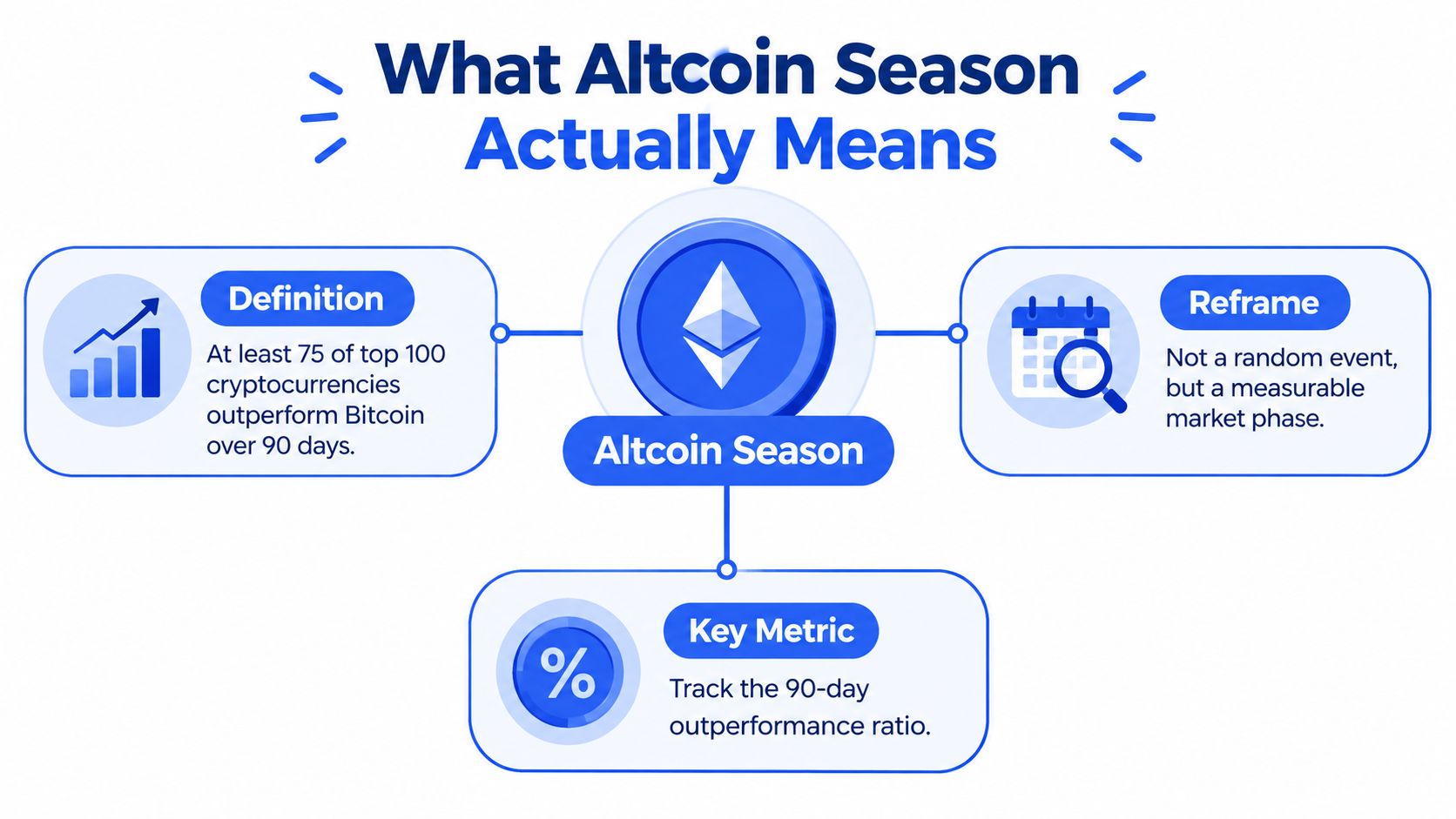
A clean definition helps, but only as a starting point. In its most common quantitative form, altcoin season means the top 100 cryptoassets are broad enough in their outperformance that at least 75 of them have beaten Bitcoin over a 90-day window, which turns a vague market mood into a measurable regime. That threshold says the market has moved beyond a single-asset trade.
The three-layer read
A trader who sees the index at 82 and sizes up immediately is missing the more important checks. A better read separates breadth, sector rotation, and token-level quality.
Breadth asks how many assets are participating. Rotation asks which narratives are pulling capital, such as DeFi, AI, gaming, or memecoins. Token quality asks whether the chart is backed by real liquidity, sane holder distribution, and execution that will not punish you on entry or exit.
Practical rule: if you cannot answer all three questions, you do not know whether you are seeing a broad altcoin regime or only a few crowded trades.
That distinction matters because two markets can both look like altseason and still reward very different behavior. One may favor large, liquid alts that track Bitcoin with a lag. Another may concentrate gains in a few speculative pockets while the rest of the market stays weak.
Three Layers of Altseason Diagnosis
| Layer | Question it answers | Best signal | Common pitfall |
|---|---|---|---|
| Breadth | How many coins are outperforming Bitcoin | A broad outperformance count over 90 days | Confusing one strong sector with a market-wide regime |
| Sector rotation | Where capital is moving first | Leadership by one narrative bucket at a time | Assuming all narratives move together |
| Token quality | Whether the coin is tradable, not just trending | Liquidity depth, holder spread, clean execution | Buying thin tokens because the regime looks bullish |
For a Solana meme-coin trader, the question is usually not whether it is altseason. It is whether the regime is broad enough to support risk, and whether the token in front of you has enough depth and distribution to survive the trade. On-chain reports help separate liquid rotations from noisy candles, so the trade is filtered by market structure, not hype alone.
The Two Cycles That Defined the Pattern
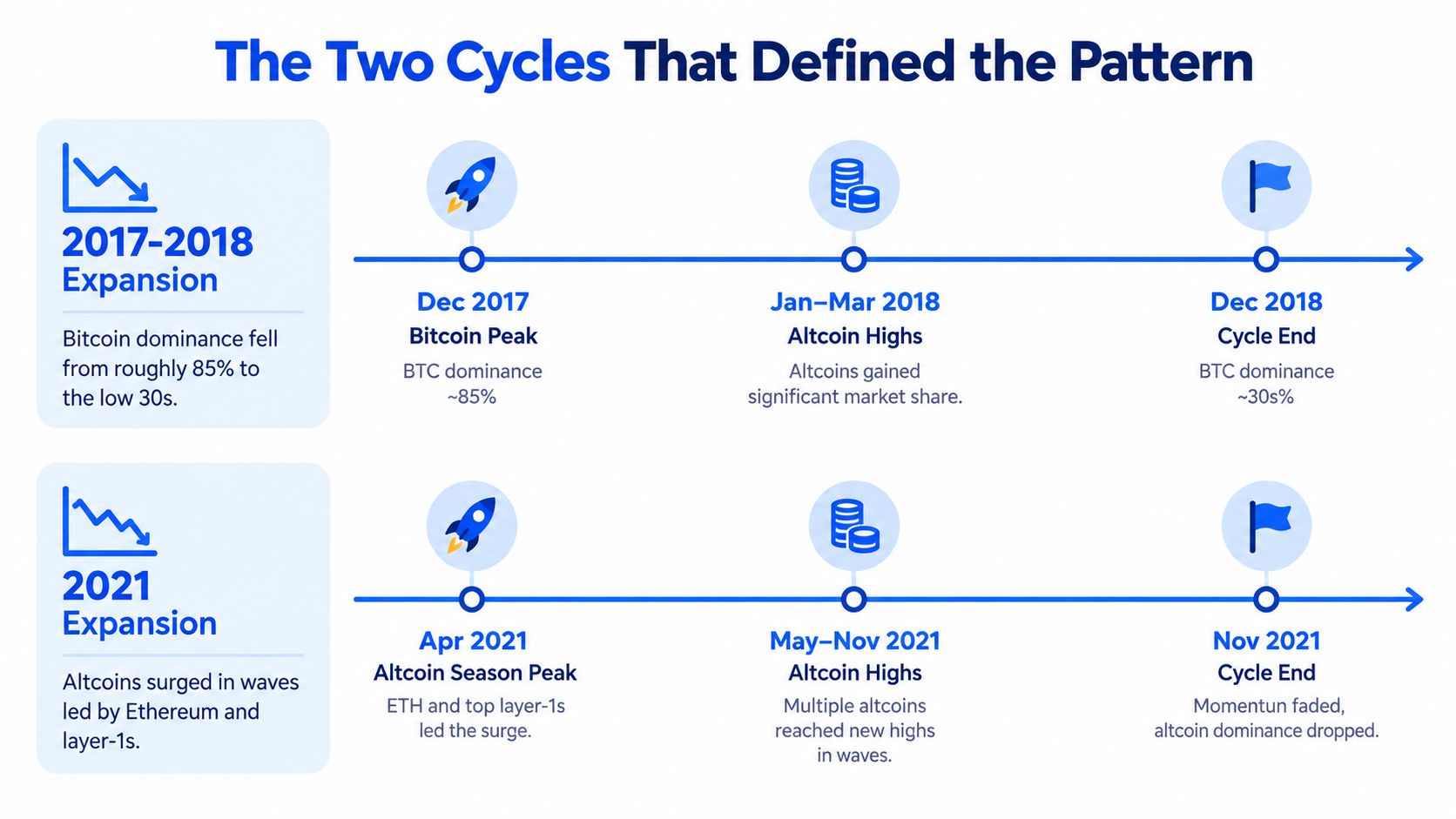
The cleanest historical examples show why altcoin season is better read as market structure than as a simple slogan. In early 2017, Bitcoin dominance fell from about 85.4% in February to roughly 40% by June, while total crypto market capitalization rose from about $20 billion to $114 billion CoinMarketCap's Bitcoin dominance history. The move was broad market expansion, not just money leaving Bitcoin.
2017 to early 2018 was a market expansion, not a simple rotation
The late-2017 rally pushed Bitcoin dominance down further, to an all-time low of about 32.8% by January 2018, as reported by CoinMarketCap's dominance history. Capital moved into Ethereum, XRP, and a long tail of other cryptoassets, but the bigger story was that the market itself was getting larger. Traders who treated falling dominance as a pure buy signal missed how much of that move came from rising participation across the whole space.
2021 was broader in narrative, not identical in structure
The next major expansion followed a different path. Bitcoin dominance fell from roughly 70% at the start of 2021 to about 38% to 40% by May, and historical descriptions place the broader altcoin expansion at roughly 309 days, from the early-year decline in dominance to the November peak. During that cycle, the ex-Bitcoin market added about $1.5 trillion and rose approximately 650% CoinMarketCap's altcoin season index.
The leadership mix also changed. DeFi, NFTs, and later memecoins each took turns driving attention and capital. That made the 2021 cycle structurally different from 2017, where the dominant theme was earlier-wave token launches and speculative repricing.
The lesson is not that one cycle predicts the next. Altcoin season recurs, but the mix of drivers keeps changing.
What the two cycles tell you
A falling dominance line during a growing market is a rotation signal. A falling dominance line during a Bitcoin drawdown is a different condition, and the trade behaves differently.
That is why the useful reading is three-layered: market breadth, sector rotation, and token-level execution quality. In a Solana meme-coin tape, the regime can look favorable while most names remain untradeable. On-chain reports separate liquid rotation from crowded noise, so the question becomes which tokens can survive the move, not whether altcoin season has been declared.
The Indicators Traders Rely On
The first signal traders watch is the Altcoin Season Index, which asks a narrow question, are enough altcoins outperforming Bitcoin over a rolling 90-day window? The second is Bitcoin dominance, a market-structure gauge, not a standalone entry trigger CoinMarketCap's Bitcoin dominance history.
Why one indicator is never enough
Breadth gauges are not interchangeable. Recent market reporting described three breadth measures sitting at 51, 60, and 66 while all stayed below the conventional 75 threshold, and each used different asset universes, exclusions, and update schedules TokenPost coverage of breadth gauges. That is a clear example of why “altseason is here” can be too blunt.
The more useful read is three-layered: market-wide breadth, sector rotation, and token-level execution quality. If DeFi is strong but gaming is weak, or meme coins are moving while the rest of the market stays flat, the trade is narrower than the headline suggests.
A fourth input is on-chain breadth. In practice, that means checking whether participation is widening or whether a move is being driven by a small set of wallets and venues.
Practical rule: use the index for direction, dominance for context, sector leadership for confirmation, and on-chain breadth for quality control.
Reading the signals together
| Indicator | What it shows | Healthy altseason signal | Watch out for |
|---|---|---|---|
| Altcoin Season Index | How many altcoins are outperforming Bitcoin | Broad, sustained outperformance | A short burst in only a few names |
| Bitcoin dominance | Bitcoin's share of total crypto market cap | A decline that fits a rising alt complex | Dominance falling because Bitcoin is underperforming on its own weakness |
| Sector rotation | Which narratives are leading | Clear leadership in one or more sectors | Chasing a hot sector that never broadens out |
| On-chain breadth | Whether participation is widening | More unique holders and healthier turnover | Volume that comes from a small cluster of wallets |
Track a live meme-season framework only after those layers line up. A single chart line cannot tell you whether a move is broad, narrow, or fake.
The decision matrix is simple. If breadth is weak and sector rotation is noisy, wait. If breadth improves, dominance softens, and one or two sectors clearly lead, the market is probably in a tradable alt regime. If the token you want still fails the liquidity test, the macro read does not save the trade.
Why Solana Meme Coins Behave Differently
Solana meme coins sit at the sharpest end of altseason behavior. They trade inside the same macro regime as larger altcoins, but their path is shaped by thinner books, concentrated ownership, and faster narrative turnover. That mix creates moves that look like momentum until the exit window opens.
Fast markets can hide fragile structure
High-frequency research shows that large- and medium-cap altcoins tend to react to Bitcoin almost immediately, while small-cap assets can lag by several minutes because lower liquidity and fewer trades slow adjustment Springer study on Bitcoin lead-lag transmission. In practice, that delay can make a weak token look stronger after the fact. The chart is catching up to the move, not proving that demand is durable.
For Solana meme coins, the execution risk is sharper because liquidity is shallow, ownership is concentrated, and order flow can swing hard on a single narrative. A token can print a clean breakout and still be one large seller away from a messy reversal. The signal on the chart is only one layer of the trade.
Macro altseason does not equal token safety
A market-wide altcoin regime can improve risk appetite. It does not remove rug, insider, or exit-liquidity risk at the token level. That is the mistake meme-coin traders keep making. They see a broad altseason signal and assume every token in the sector has been upgraded.
What matters is whether the move is broad enough to support follow-through and whether the token itself still has healthy execution. That means checking if volume is rising with unique buyers, whether liquidity can absorb your size, and whether holders are spreading out or clustering into a few wallets.
A delayed pump is not the same thing as durable demand.
For Solana, that distinction matters more than it does in large caps. A meme coin can outperform Bitcoin inside an altseason and still be untradeable if the market structure is weak.
A Real-Time Spotting Workflow
A workable screen starts with the regime, then moves to sector flow, then to the token itself. That order matters because a broad altseason signal can still hide weak microstructure.
A five-minute routine
- Check altcoin breadth first. If the market is not near the commonly used 75 of 100 threshold, the regime may still be mixed rather than full altseason.
- Read Bitcoin dominance as context, not as a trigger. A lower number matters only if breadth and market expansion agree with it, as shown in CoinMarketCap's Bitcoin dominance history.
- Identify the leading sector. If the move is concentrated in one narrative, trade that narrative instead of treating the whole market as one signal.
- Inspect token health before entry. For Solana meme coins, that means holder concentration, liquidity depth, and trading behavior, not just price direction.
The logic is straightforward. Macro breadth shows whether risk appetite is present. Sector rotation shows where that appetite is going. Token checks show whether the trade can be entered without paying too much in slippage, dealing with concentrated wallets, or chasing a late move.
The token-level report you actually need
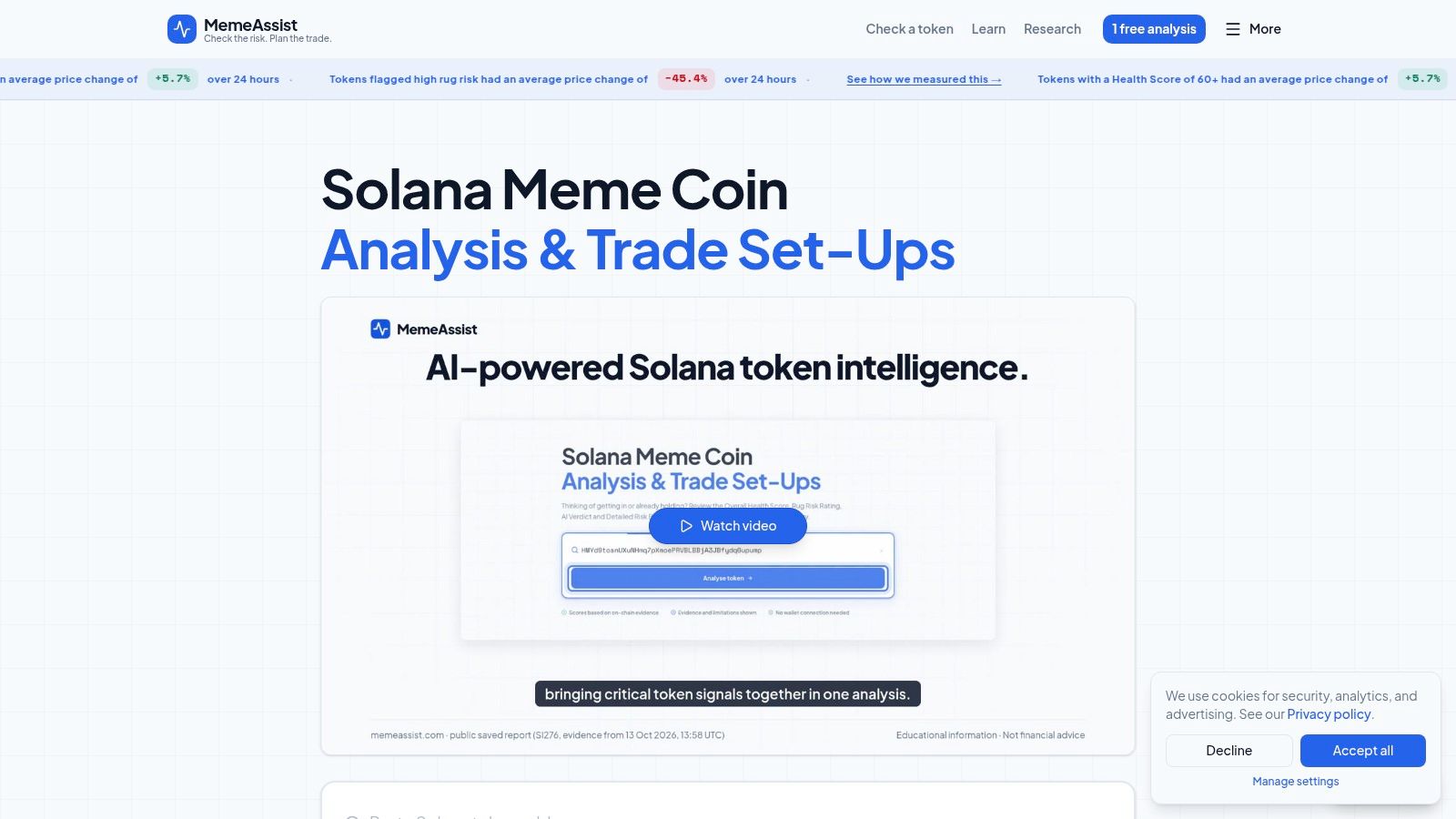
A useful report focuses on a few checks. Overall health shows whether the token still looks structurally tradable. Rug risk shows how much hidden downside sits under the chart. Holder concentration shows whether ownership is spread out enough for real price discovery. Liquidity depth shows whether your size is likely to move the market. Trade setup shows whether current conditions are actionable.
A Solana market-radar workflow helps turn that regime read into a decision you can trade. The macro screen gets you into the right area. The token report tells you whether the structure is sound enough to press the entry.
Trading Tactics and Risk Management
There's a big difference between trading a large-cap alt and trading a Solana meme coin inside the same regime. Large caps can often be approached with sector rotation and more normal sizing. Meme coins need stricter controls because the upside can be fast, but the failure modes are faster.
Large-cap alts and meme coins need different playbooks
For larger alts, the cleaner tactic is to rotate between sectors and use dominance or breadth deterioration as your exit cue. You still size carefully, but the market can usually absorb more normal participation. The trade is closer to a regime bet.
For Solana meme coins, the trade is more surgical. You need a smaller position, a hard liquidity floor, and a willingness to walk if the holder profile looks wrong. If the token's distribution is concentrated, the chart can still rise while your exit quality collapses.
Practical rule: a broad altseason increases opportunity, but it also increases the number of speculative tokens that can trap late buyers.
Risk controls that actually matter
- Size down aggressively: meme coins should never be treated like a core alt position.
- Set a liquidity floor: if the book is too thin, skip the trade.
- Re-check the token after a sharp move: late-stage pumps often reveal the risk only after the chart looks strongest.
- Watch for insider-like behavior: bundle activity, sudden wallet clustering, or odd volume spikes can invalidate the setup.
- Use exits, not hopes: if the structure changes, get out.
Broad participation is double-edged because it brings more highly borrowed and illiquid tokens into the rally. That creates opportunity, but it also expands the surface area for bad fills, abrupt reversals, and tokens that look liquid only while the crowd is still buying.
If you want a simple mental model, use this one, large-cap alt trades can be framed around regime confirmation, but meme-coin trades must be framed around regime confirmation plus execution quality. Leaving out either side is how traders turn a correct macro view into a bad trade.
Common Misconceptions That Cost Traders Money
The most expensive mistake is treating falling Bitcoin dominance as proof of a broad alt rally. Dominance can drop because Bitcoin is lagging, while the rest of the market remains thin and uneven, and those are very different conditions CoinMarketCap's Bitcoin dominance history.
The label is not the trade
Altcoin season is often treated as a binary switch. In practice, market breadth can stay below the usual threshold while a few narratives still rip hard, which is why traders can see strong altcoin moves without a full regime change, as noted in TokenPost coverage of breadth gauges.
The institutional-flow contradiction is just as important. Coverage has described Bitcoin dominance near 59% to 60% while Bitcoin ETF inflows remain strong and breadth stays below the usual altseason threshold, which means Bitcoin can still absorb most net institutional demand even as selected altcoins rally Bitcoin Foundation report on Bitcoin dominance. When ETF inflows and sub-threshold breadth coexist, treat altcoin exposure as a sector bet, not a regime bet.
What to ask instead
A better question is whether the move has spot volume, durable liquidity, and wider participation, or whether it is being driven by borrowed buying power and narrative heat. A few coins can run hard without creating a healthy market regime.
The useful takeaway is simple. Buy the structure, not the headline.
A Pre-Trade Checklist for Any Altcoin Buy
Before you size into any alt during an altcoin season, check three layers in order. First, confirm the market-wide breadth with at least two indicators, because no single index tells the whole story. Second, confirm the sector is leading and not just catching a temporary bid. Third, confirm token-level quality through an on-chain report that covers health, rug risk, holder concentration, liquidity depth, and trade setup.
Simple pre-trade questions
- Is breadth strong enough? If not, the move may be isolated.
- Is my sector leading? If not, you may be early or wrong.
- Can this token support my size? If not, the chart is lying to you.
- Do the wallets look healthy? If not, the risk may be hidden until you're already trapped.
- Would I still want this trade if the next wick is lower? If not, the entry is too loose.
A quick rule set helps. Use the macro regime to decide whether you should be in the arena at all. Use sector rotation to decide where to focus. Use the token report to decide whether the specific coin is worth the risk.
Check a Solana meme coin's risk score before you put money into it, especially if the move looks too clean to be real. A favorable altseason label lowers the bar for participation, but it does not lower the bar for due diligence on the token itself.
MemeAssist gives Solana traders a fast way to turn a noisy chart into a clearer risk read, with live on-chain checks for holder concentration, liquidity, trading behavior, and scam patterns. If you're trading meme coins inside an altcoin season regime, visit MemeAssist and use the report before you size in, not after the token has already moved against you.