Key Learnings
- 01Beyond a basic free scan: six signal categories, four explained report outputs, visual early-wallet evidence, conditional trade setups and comparisons between dated analyses.
- 02Evidence beyond the explanation: a published historical study covered 3,971 resolved observations. High-risk observations had a 53.2% dead-pool rate versus 13.6% in the Low band—not a guarantee of safety or profit.
- 03Lower commitment for selective research: a $5 top-up covers 25 analyses at the checked $0.20 price. Optional tools cost separately; subscription plans can suit heavier or broader usage.
Yes—for a Solana trader who wants a clear, connected investigation before buying or while holding, MemeAssist makes a strong case. You get more than another risk number: the findings behind it, visual wallet evidence, conditional trade context and a way to revisit what changed.
The right comparison is not “can I find blockchain data for free?” You can. It is “what does it take to turn that data into a useful investigation—and what am I paying for the research I actually use?”
This is MemeAssist's own product assessment, not an independent review. Product prices and the linked competitor terms were checked on 23 October 2026. The two sections below compare the workflow with free tools, then the value against paid subscriptions. Historical research is dated separately and is not a head-to-head performance test.
1. MemeAssist vs free tools: what are you actually adding?
Free tools are useful. A contract checker can highlight token permissions; a chart can show price and trading activity; an explorer can expose transactions; a specialist wallet tool can help you investigate supply. If you enjoy assembling and interpreting those pieces yourself, that may be enough.
MemeAssist adds the prepared investigation. It connects the findings, explains why they matter and helps you distinguish a safety concern from a poor entry, a changed position or missing evidence. That is a different job from returning a list of blockchain facts.
From disconnected flags to an explained report
A full analysis evaluates six signal categories: liquidity, holder distribution, creator behaviour, wallet activity, trading patterns and historical risk indicators. Mint and freeze-authority checks are included; creator-history findings are included where evidence is available. A separate creator wallet investigation can add depth.
The findings feed four report outputs: the Overall Health Score, Rug Risk Rating, AI Verdict and Detailed Risk Breakdown. You can start with the summary, then inspect the evidence behind it. A low detected risk is not the same as a good entry, and an unknown is not quietly treated as safe.
| Your research question | What MemeAssist adds to the workflow |
|---|---|
| Which findings deserve attention? | Connected risk evidence, plain-English explanations and visual summaries—not just isolated warning labels. |
| Is a cleaner-looking token a sensible entry? | Separate safety and setup assessments, with conditional entry, stop-loss and target levels when price structure supports them. |
| What happened to the early supply? | An early-buy wallet constellation and selected-wallet details, with timing, transfers and current holdings kept distinct. |
| What changed since my last check? | Comparisons of supported measures between dated saved analyses, rather than relying on memory of an older score. |
| What matters now that I own it? | Holding-focused context, supported monitoring and alerts, plus an optional position-sized Exit Liquidity Check. |
| What if the report raises another question? | Optional Ask the Analyst answers grounded in evidence collected for that token's report. |
| Do the warnings relate to later outcomes? | Recorded analysis-time outputs, subsequent price-outcome tracking and published findings with dates and limitations. |
This is what a basic free scan does not provide as a complete research workflow. It is not a claim that every individual feature is absent from every free product. Charts, wallet graphs, AI assistance and alerts overlap across tools. MemeAssist's case is how the investigation works together around your token.
Research the decision—not just the token
Before buying, you want to know what would make an entry valid and what would invalidate it. While holding, you may care more about creator selling, whale activity, exit liquidity or a change in the evidence behind your original decision.
MemeAssist reflects those different questions. Every full analysis checks for a Trade Setup, but it should only show entry, stop and target levels when the structure supports them. “Take” requires reading the stated conditions; it is not permission to buy at any price. A “Wait” assessment for a new entry is not automatically an instruction to sell an existing position.
That distinction is easy to lose when you combine a green contract check with a chart that happens to be rising. Read the MemeAssist analysis methodology for how the report's evidence and outputs fit together.
Visual evidence you can investigate and revisit
The wallet constellation helps you explore early-buy exposure, selected-wallet holdings and supported connections. It does not equate same-slot timing with common ownership, or a transfer with a sale.
Saved comparisons provide another useful distinction: a token can improve on one measure and weaken on another. In the saved DOWGE example below, between observations on 15 and 21 October 2026, the Health Score rose by two points and reported liquidity increased approximately 2.26%, while buying's share of observed trailing-24-hour activity fell by 8.02 percentage points.
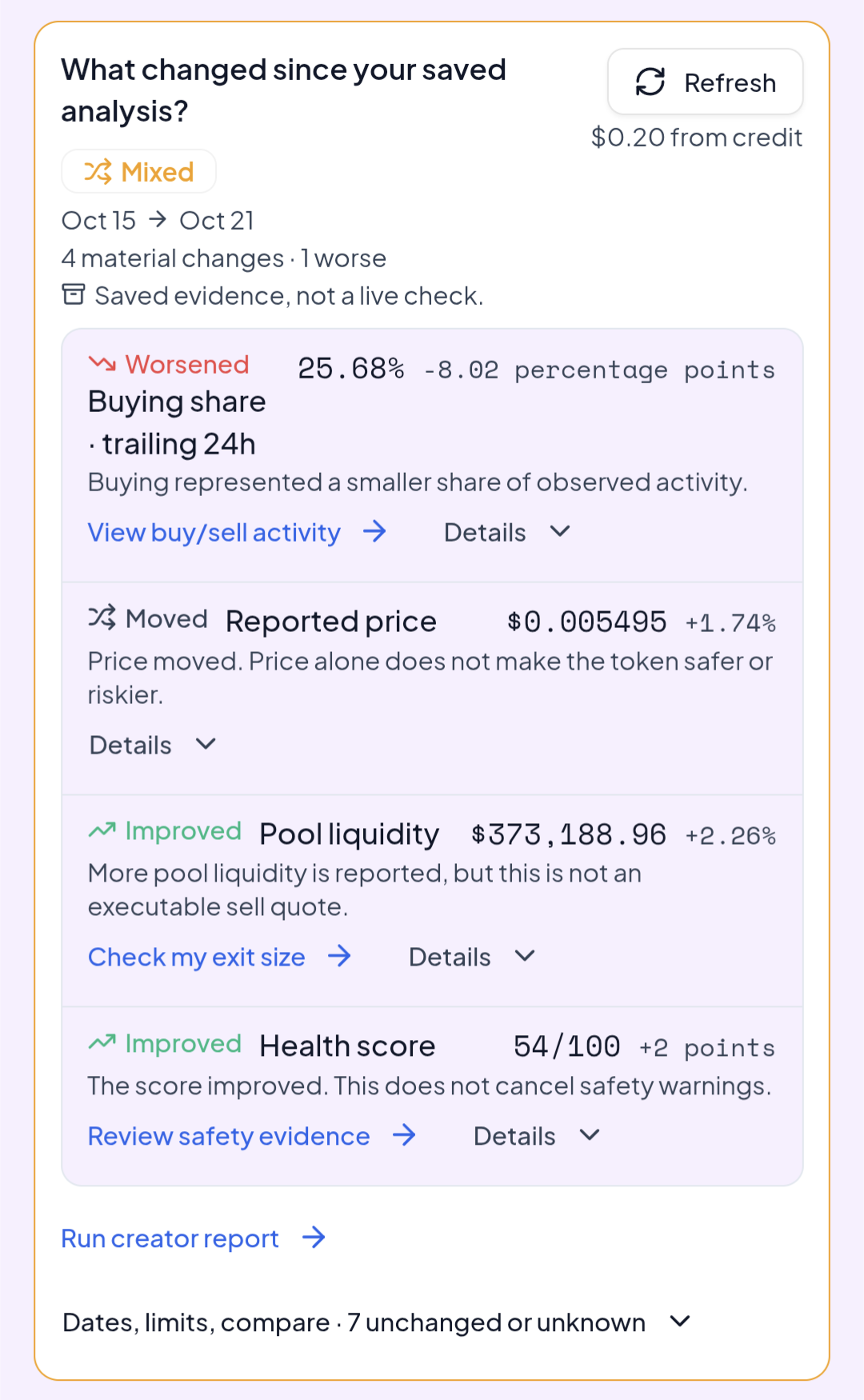
“The score went up” would miss that mixed picture. Explore the dated report comparison and inspect what was actually measured. Comparisons leave gaps between observations; they do not reconstruct everything that happened in between.
We measure what follows our outputs—not just how convincing they sound
A useful analysis tool should be accountable after it publishes a verdict. MemeAssist records analysis-time evidence and scores, follows subsequent price outcomes and compares the results. That creates a data-driven feedback process: record → follow → compare → review → test refinements.
The point is to check whether a warning actually distinguishes worse outcomes, identify weak or contradictory signals and inform evidence-led calibration—not simply restate on-chain data in fluent prose. Outcome tracking is not the same as proving every insight improves a customer's returns, and it does not mean the live model automatically retrains after each token.
One published historical study makes this concrete. The approved snapshot through 31 August 2026 contained 3,971 resolved observations with a recorded Rug Risk Score:
| Recorded risk band | Resolved observations | Tracked pools classified dead | Average 24-hour return |
|---|---|---|---|
| High (75–100) | 914 | 486 · 53.2% | −54.7% |
| Medium (30–74) | 888 | 121 · 13.6% | −15.8% |
| Low (0–29) | 2,169 | 294 · 13.6% | −18.2% |
The High band's observed dead-pool rate was approximately 3.9 times the Low band's. That supports a specific use: taking severe-risk warnings seriously. It does not make a score a probability of fraud, and a pool classified dead is not proof of a criminal rug pull.
The feedback also exposes where the story is less tidy. Medium and Low did not form a clean performance ladder, and all three groups had negative average returns. Publishing that limitation is part of the value: evidence should challenge the score, not become marketing that protects it.
Study limits: this was a selected historical analysis cohort, not a random market sample or a test of today's exact model. Missing and unresolved outcomes were excluded; dead tracked pools were assigned −100% in this study. There were no confidence intervals or significance tests, public row-level records are unavailable, and records were not manually verified one by one. These are observational aggregates, not realised customer trading returns or proof that using MemeAssist causes better returns. Read the full 3,971-observation study and methodology.
Our public Track Record reports dated measured outcomes, while the Research Centre explains published findings and limits. Ongoing customer outcome collection checks later prices; it is not a fresh paid analysis, a continuous social-data rescan or an automatic trade. The aim is simple: keep the insights accountable to what happens next.
When is a free workflow still enough?
If you only want a basic authority check, already know how to investigate wallets and are happy to maintain your own comparison notes, free tools can be sufficient. MemeAssist becomes worth considering when interpretation, conditional trade context and continuity are the work you want help with.
For a fuller feature discussion, see what makes MemeAssist different from free memecoin tools. For the separate question of custom datasets versus a prepared token report, read Dune vs MemeAssist.
2. MemeAssist vs paid subscription tools: better value for the research you use
You should not need a recurring analytics bill just to investigate a few Solana candidates properly. MemeAssist gives selective researchers a lower starting commitment: add prepaid credit, pay for the actions you run and reopen saved reports for free. No subscription to keep renewing while you wait for a token worth researching.
At the checked price of $0.20 per full analysis, a $5 top-up covers 25 analyses if spent only on analyses. Eligible new accounts can first try one free full analysis, with no card or wallet connection required at signup.
Compare the commitment—not a misleading “price per scan”
| Option | Published paid commitment | What the comparison means |
|---|---|---|
| MemeAssist | $5 initial top-up; 25 analyses at $0.20 each when used only for analyses. | Prepaid individual actions, without a subscription. Monitoring, questions and diagnostics consume credit separately. |
| DeFade Pro | $24/month for 300 scans and its listed Pro modules. | A multi-chain subscription with deep wallet, bundle and other research features. Its separate free tier offers 3 core scans/day. |
| Nansen Pro | $69/month on monthly billing, or $49/month billed annually ($588/year). | A broader multi-chain analytics product with wallet labels, portfolios, AI credits and smart alerts; not a like-for-like token-report bundle. |
For a 25-analysis, analysis-only use case, MemeAssist's $5 starting spend is $19 below DeFade Pro's $24 monthly commitment and $64 below Nansen Pro's $69 monthly commitment. Those are differences in starting spend for this use case—not claims that the products contain identical features.
The comparison changes at high volume. DeFade's $24 divided by all 300 included scans is $0.08 per scan if you use the full allowance. Three hundred MemeAssist analyses consume $60 of credit at the base $0.20 price before top-up bonuses or free benefits. A subscription can be better value for a heavy scanner or someone who needs its broader tools. And free competitor access may already meet a basic need.
That does not weaken the selective-research case. It makes it precise: buy the focused investigation you need, rather than paying a recurring fee for capacity or breadth you may not use.
A realistic research-and-follow-up budget
It is easy to advertise a cheap analysis and leave the extras unexplained. Here is a paid-use illustration using MemeAssist's prices checked on 23 October 2026, excluding the free analysis and top-up bonuses:
| Actions | Calculation | Credit consumed |
|---|---|---|
| 10 full analyses | 10 × $0.20 | $2.00 |
| 5 answered Ask the Analyst questions | 5 × $0.10 | $0.50 |
| 5 Exit Liquidity Checks | 5 × $0.05 | $0.25 |
| 3 tokens monitored for 7 charged days each | 3 × 7 × $0.10 | $2.10 |
| Total | Illustrative paid research basket | $4.85 |
That fits within a $5 top-up and leaves $0.15 of credit under these assumptions. It is a budget illustration, not a bundled offer or an outcome forecast. Monitoring continues to incur daily charges while active: remove a token when you no longer want that service. Fresh-launch monitors and creator investigations have their own terms. Always check current per-action pricing before spending.
The feature difference is focus, not just a smaller bill
Paying less would not matter if the report did not answer your question. MemeAssist is built around a particular sequence: investigate this Solana token, understand the risk, review conditional trade structure, explore the wallets, then follow changed evidence if you choose.
- Safety and setup stay separate. A reassuring authority check does not override weak price structure or verified historical market damage.
- The same report supports different trading stages. Research a possible entry or focus on the concerns relevant to an existing holding.
- Visuals connect to explanations. Investigate early supply and wallet evidence without reducing every connection to an accusation of common control.
- Revisits have context. Compare dated saved findings instead of reading a fresh number as though nothing came before it.
- Follow-up is optional. Add report-grounded questions, supported alerts, monitoring or size-specific sell quotes where they answer a real research need.
- Outputs face an outcome check. Recorded observations and later results support published evaluation and evidence-led review, not just convincing AI wording.
Paid competitors have valuable overlapping features. DeFade lists wallet graphs, creator tools, bundle research and exit-liquidity tools; Nansen offers broad wallet intelligence, AI and alerts. We do not claim those categories are exclusive to MemeAssist. Our differentiator is the Solana-focused combination of explained evidence, conditional plans, dated comparisons and pay-as-you-go follow-up.
The verdict: is MemeAssist worth it?
If you want a Solana meme coin analysis tool that helps you make sense of the evidence—not just collect more of it—MemeAssist is worth trying. The strongest fit is the trader who researches selectively, wants a structured second opinion and does not need a broad analytics subscription every month.
Free tools remain a good choice for self-directed basic checks. A paid platform may suit heavy scanning, multi-chain research or specialist workflows better. But for focused Solana token research, MemeAssist combines a low starting commitment with a report and follow-up workflow built for the decision in front of you.
Start with your free full analysis if eligible. Use a token you know, inspect the explanations and visuals, review any conditional setup and judge whether the report improves your research. Check live pricing before adding credit.
MemeAssist provides informational research, not financial advice. Reports can be incomplete, mistaken or outdated; AI can misinterpret data, quotes are not guaranteed fills and alerts may be delayed. No tool guarantees safety or profit, and memecoins can lose their entire value.
Frequently asked questions
Is the MemeAssist meme coin analysis tool worth paying for?
It is a strong fit for selective Solana research when you want an explained investigation, conditional setups and dated follow-up without assembling separate tools yourself. At prices checked on 23 October 2026, a $5 top-up covers 25 analyses if spent only on analyses. Optional tools cost separately.
What does MemeAssist add beyond free token scanners?
MemeAssist combines six categories of risk evidence, four explained report outputs, conditional setups when supported, visual early-wallet research and saved-analysis comparisons. Optional report-grounded questions, monitoring and exit-liquidity checks continue the investigation. Some individual features overlap with free tools; the added value is the prepared workflow.
Is MemeAssist cheaper than subscription analysis tools?
For selective analysis-only use, the checked $5 initial top-up is below DeFade Pro's $24 monthly and Nansen Pro's $69 monthly commitments. These products are not identical. Heavy scanning can favour a subscription, and free tiers may suffice. Compare current prices, allowances and separately charged tools.
Does MemeAssist track whether its outputs match later outcomes?
Yes. It records analysis-time outputs and follows later price outcomes, supporting comparisons, published research and evidence-led review. That feedback is designed to test the usefulness of signals; it does not establish that every insight improves returns or that a live model automatically retrains after each token.
What evidence supports MemeAssist's risk warnings?
A published historical snapshot through 31 August 2026 covered 3,971 resolved observations. The High band had 486 dead-pool classifications out of 914 observations (53.2%), versus 294 of 2,169 (13.6%) in the Low band. It was selected observational data, not a fraud-detection accuracy test or customer trading return study. Medium and Low did not rank cleanly; read the full study's limitations.
Are monitoring and analyst questions included in an analysis?
No. A completed full analysis includes its report and a conditional Trade Setup when supported. Monitoring, answered analyst questions, exit-liquidity diagnostics and fresh-launch monitors have separate charges. Reopening a saved report is free; running a fresh analysis is a paid action after applicable free benefits.
Can I try MemeAssist without a subscription or wallet connection?
Eligible new accounts receive one free full analysis, with no card or wallet connection needed at signup. Further paid actions use prepaid account credit; there is no subscription. Check current pricing and eligibility terms before using paid tools.
Does a low rug-risk score mean I will make money?
No. Safety findings and entry quality are different questions. Even the lower-risk group in the cited historical study had negative average returns. Read the evidence, missing coverage, dates and conditional setup rather than treating any score as a buy recommendation.
Sources & further reading
- MemeAssist current per-action pricing — checked 23 October 2026
- MemeAssist methodology: six signal categories and report outputs
- Published 3,971-observation study — historical snapshot through 31 August 2026, methodology clarified 2 September
- MemeAssist dated public outcome tracking
- Saved product examples and dated comparison context
- DeFade official pricing and feature allowances — checked 23 October 2026
- Nansen Pro official monthly and annual pricing — checked 23 October 2026
Related guides
MemeAssist vs Free Memecoin Tools
Discover MemeAssist’s visual Solana memecoin reports, wallet constellations, trade setups, saved comparisons, alerts and exit liquidity checks.
How the AI Analyzes Tokens
Beyond a free token scan: how MemeAssist connects Solana risk checks, wallet evidence, explained verdicts, conditional trade setups and optional follow-up.
Rug-Risk Scores vs. 24-Hour Outcomes
Study of 3,971 resolved Solana token outcomes: high rug-risk scores were linked to 53.2% dead pools, while medium and low bands did not rank cleanly.
Dune vs MemeAssist
Compare Dune Analytics and MemeAssist for Solana token analysis: custom dashboards versus explained memecoin risk, wallet evidence, trade setups and follow-up.
MemeAssist vs Nansen Solana (2026)
MemeAssist vs Nansen Solana compared: Smart Money wallet labels and analysis versus meme coin health, creator signals, outcomes, setups and alerts.
Make the Most of MemeAssist
Check a Solana token, read Trade Check and the underlying risk evidence, choose the right report view, then monitor conditions that could change your decision.
Continue: Before You Buy
More evidence-led reading for this decision stage.
Run these checks automatically
Paste any Solana mint address into the MemeAssist analyzer for holder intelligence, authority checks, creator history and an AI health score in one report. New accounts get 1 free full token analysis with Trade Setup. Further analyses and other paid tools require account credit.
Try with 1 free full analysis