Key Learnings
- 01Choose Dune for custom SQL research, public dashboards and broader on-chain questions. Choose MemeAssist for an explained investigation of an individual Solana memecoin.
- 02Both offer visual analysis, AI-related tools and alerts. MemeAssist's added value is connecting token safety, wallet evidence, conditional setups and dated follow-up in a ready-to-use report.
- 03MemeAssist is not a replacement for Dune's data platform. Neither a dashboard nor a favourable token report guarantees safety, execution or profit.
Searching for a Solana analysis tool can bring up both Dune Analytics, at dune.com, and MemeAssist. They overlap around wallets, trading activity and token research, but they are not interchangeable products.
If you want to investigate one Solana memecoin without building the research workflow yourself, start with MemeAssist. If you want to define your own metrics, compare protocols or build an on-chain dataset and dashboard, Dune is the more appropriate starting point.
This is a first-party comparison by MemeAssist Research, not an independent product ranking. Dune's linked documentation and pricing were reviewed on 23 October 2026. The comparison concerns research workflows, not a measured contest in accuracy, speed or investment returns.
Dune vs MemeAssist at a glance
| Research task | Dune Analytics | MemeAssist |
|---|---|---|
| Primary focus | Broad on-chain analytics, reusable datasets, queries and dashboards across blockchains. | Explained research for an individual Solana memecoin, before entry or while holding. |
| Getting started | Explore an existing public dashboard; adapt or build queries for a custom question. | Paste a token mint, run an analysis and inspect the findings and supporting evidence. |
| Wallet and trading research | Solana transaction, account-activity and trading datasets support custom wallet and token analysis. | Holder distribution, creator evidence, early-buy wallet visuals and trading signals in the token report, where covered. |
| AI assistance | Documented tools generate, edit and debug SQL; agent integrations also support data workflows. | Plain-English interpretation of collected token evidence, plus optional report-grounded Ask the Analyst questions. |
| Trade context | Depends on the dashboard or analysis you choose or construct. | Separates token safety from setup quality; checks for conditional entries, stops and targets when supported. |
| Revisiting a token | Historical queries and scheduled dashboards can track metrics defined by their author. | Saved-analysis comparisons show supported changes between dated reports. |
| Alerts | Scheduled-query notifications through email and webhooks, subject to current access terms. | Optional token monitoring and supported alerts, with in-app and optional Telegram delivery. |
| Access model | A free viewing tier; paid analytics plans and usage credits for additional work. Check current plan terms. | One free full analysis for eligible accounts, then prepaid actions without a subscription; optional tools cost separately. |
The distinction is not “Dune has data, MemeAssist has AI.” Both have data and AI-related capabilities. The distinction is custom research flexibility versus a purpose-built token investigation.
What Dune does well for Solana research
Dune's Solana documentation describes raw transactions, account activity, instruction calls and decoded program data. Its trading datasets let analysts investigate exchange activity and token flows. That makes Dune useful for questions such as:
- How has trading activity changed across Solana exchanges or launch platforms?
- Which wallets meet a researcher's specific accumulation definition?
- How does a token cohort behave over a chosen historical window?
- What happens when you change a metric's inclusion rules or join another dataset?
You do not need to write SQL just to read someone else's public dashboard. Dune also documents AI Query Tools for creating, editing and debugging queries. It would be wrong to describe the platform as offering no help to non-SQL users.
There are token-specific dashboards too. For example, the community-authored Solana Tokens Analysis dashboard by skipper10 includes sections for holders, trading volume, accumulation and trading PnL. This is evidence of workflow overlap, not our endorsement of that dashboard's methodology or a test of its results.
Dune is a strong fit when you want control over the question, the dataset and the calculation. MemeAssist does not offer a general-purpose SQL workspace or replace that flexibility.
Where MemeAssist adds value for an individual memecoin
A dashboard showing activity still leaves a trader with several questions: is that activity concerning, which findings deserve attention, and does the price structure support an entry at all?
MemeAssist organises the investigation across six signal categories: liquidity, holder distribution, creator behaviour, wallet activity, trading patterns and historical risk indicators. Mint and freeze-authority checks are included in the analysis; available creator-history findings are not left entirely to a manual checklist.
The report connects those findings through four named outputs: Overall Health Score, Rug Risk Rating, AI Verdict and Detailed Risk Breakdown. The explanation matters more than having one more number: open the evidence to see what was observed, what it suggests and what is missing.
This is the paid-value case: a structured investigation and interpretation, not exclusive ownership of public blockchain facts. Read how MemeAssist analyses Solana tokens for the methodology, and the free-tools comparison for a wider view of overlapping capabilities.
Separate a safer-looking token from a better entry
Revoked authorities do not make a damaged chart a good entry. Equally, a rising chart does not cancel a concerning supply distribution. MemeAssist separates token-safety evidence from setup quality and historical market damage.
A full analysis checks for a conditional Trade Setup. When the price structure supports it, the report can show entry conditions, stop-loss and target levels; otherwise it should explain why no validated setup is available. Take, Wait and Avoid need to be read with that context. They are not guarantees or instructions to buy immediately.
An analyst could build trading metrics or a custom risk model on Dune. MemeAssist's advantage for this task is that the structured report and conditional-setup workflow are already provided—not that Dune's data could never support similar research.
Investigate early wallets without treating timing as ownership
MemeAssist's wallet constellation helps explore early-buy exposure alongside selected-wallet details. Its visual distinctions matter: same-slot timing alone is not proof of shared ownership, and a transfer is not automatically a sale.
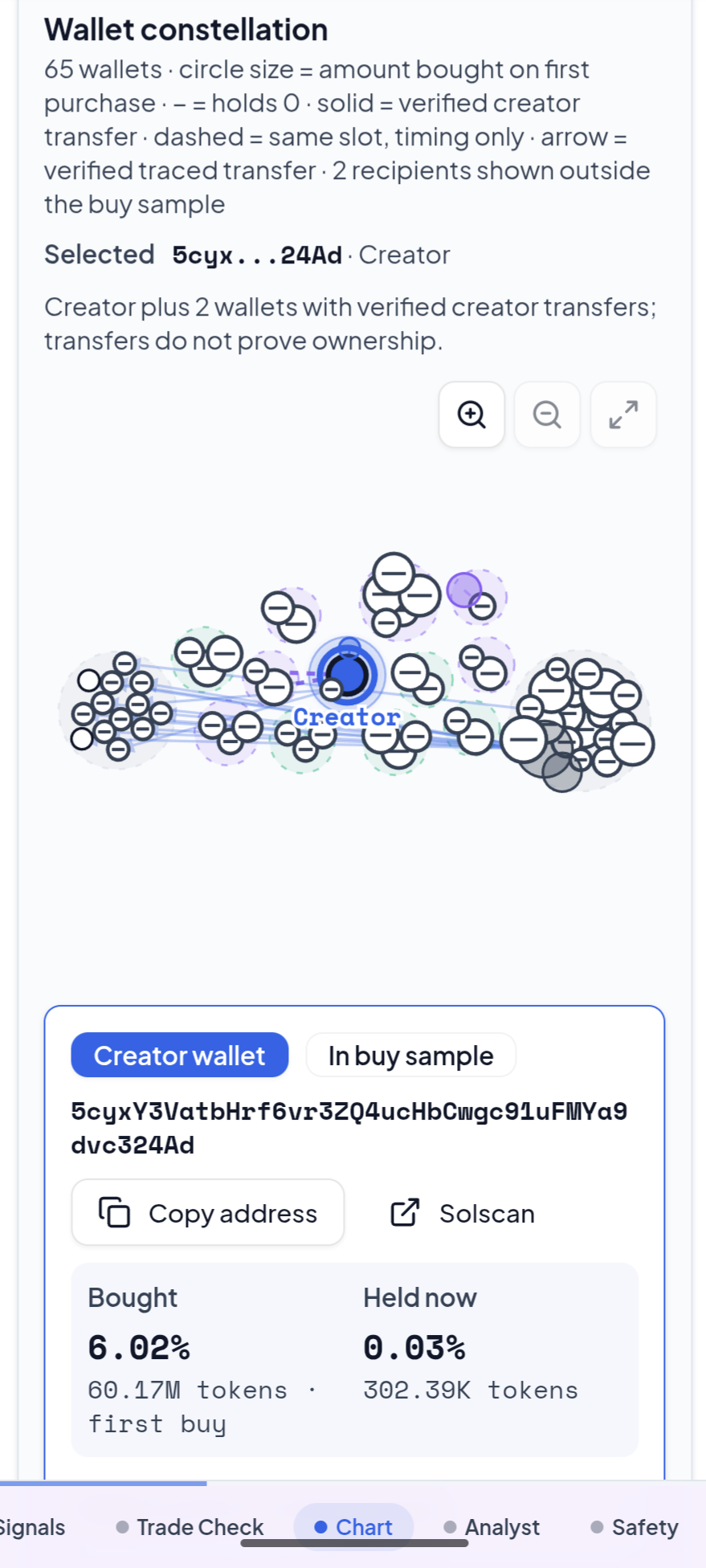
Dune can support wallet research as well. The difference here is getting a ready-to-explore view inside the same token investigation, rather than choosing or constructing a separate analysis and combining the interpretation yourself.
What does useful follow-up look like? A dated example
One reason to return to a token is to understand what changed—not simply get another score. MemeAssist compares supported measures between saved analyses, with observation dates attached.
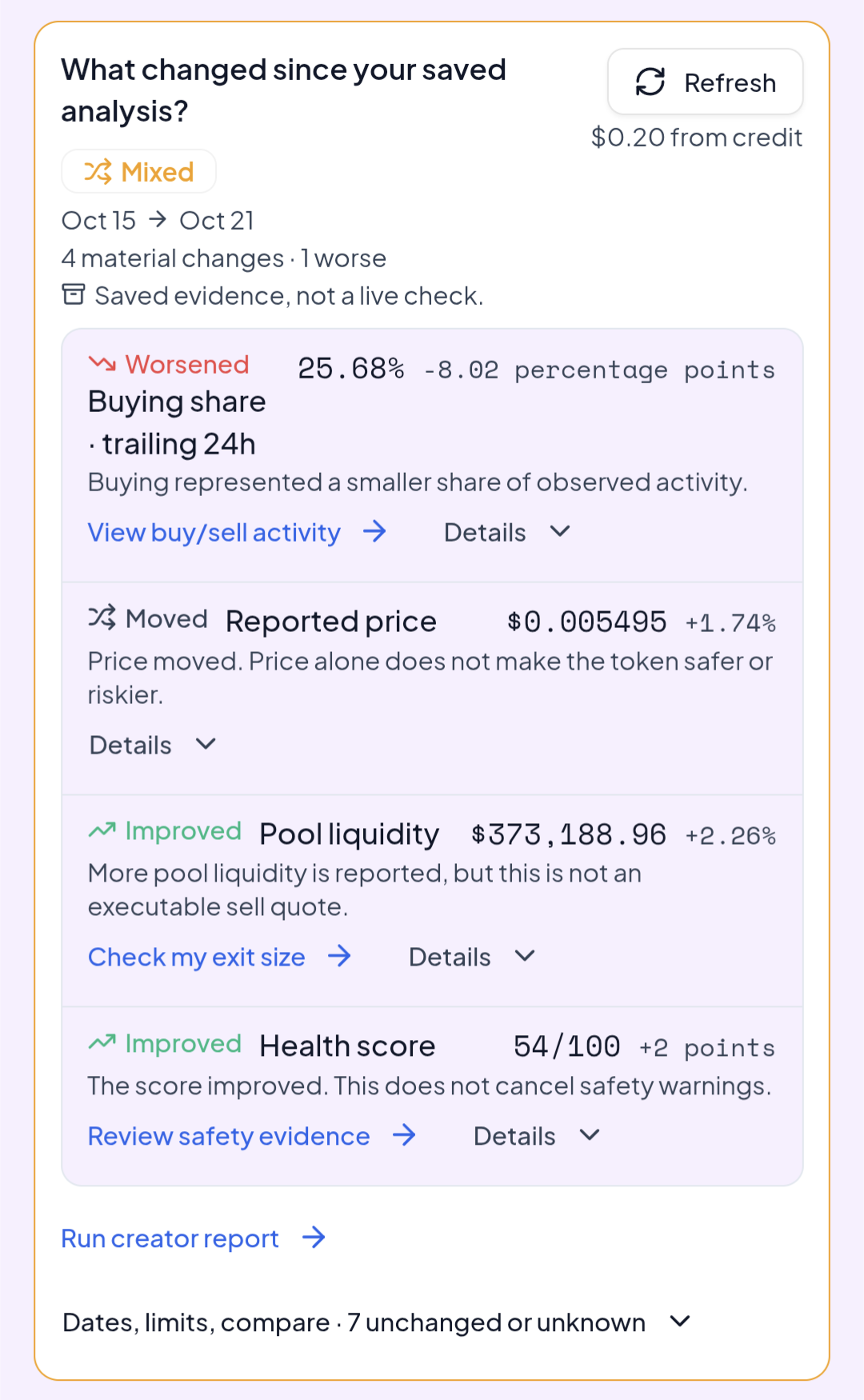
Between those saved observations, the Health Score increased by two points and reported pool liquidity increased by approximately 2.26%. But buying's share of observed trailing-24-hour activity fell by 8.02 percentage points.
That is a mixed picture, not simply “the token improved.” The value is making the differences and measurement windows visible. It does not establish what happened between observations, predict the next price move or prove performance against Dune. Explore the saved report comparison.
Dune can also compare historical metrics and schedule dashboards. MemeAssist packages the comparison around saved token reports, without asking the user to define the comparison query.
"A dashboard can answer the question you build into it. MemeAssist gives you a structured set of questions to ask before buying—or while holding—a Solana memecoin."
Already holding? Go beyond the headline token price
When you own the token, the research question changes. You may care less about finding an entry and more about creator selling, whale activity, deteriorating liquidity or whether your original reasoning still holds.
MemeAssist provides holding-focused context and an optional Exit Liquidity Check: point-in-time sell quotes at chosen sizes, with estimated proceeds and exit cost relative to a reference price. This is a separate paid diagnostic, not a guaranteed fill or an automatic sale.
You can also ask token-specific questions through Ask the Analyst, grounded in evidence collected for the report, or activate supported monitoring and alerts. Questions, monitoring and diagnostics have separate charges. A saved report does not mean every field updates continuously, and monitoring can miss or report a sudden event late.
Dune's own alert documentation describes email and webhook notifications after scheduled-query execution. We do not claim alerts are unique to MemeAssist. Compare the monitored condition, observation time, delivery method and limitations—not just whether a product has an alerts checkbox.
How fresh is the data in each Solana analysis tool?
Freshness is a property of the specific data and workflow, not a blanket promise attached to a brand.
At review, Dune's data-freshness documentation states that certain curated Solana tables, including dex_solana.trades and tokens_solana.transfers, run on a six-hour schedule and typically have six-to-seven-hour freshness. That statement does not describe all Dune raw data, decoded tables, feeds or products. A dashboard's own last execution adds another consideration.
MemeAssist also depends on provider coverage, observation times and cached or saved evidence. Running a new analysis is different from reopening an old report; optional monitoring has its own polling and delivery constraints. We have not conducted a matched latency benchmark against Dune.
For either tool, check what was measured, the timestamp, the window and missing coverage before applying a finding to a fast-moving position. Unknown evidence is not a safety clearance.
Pricing: a research platform versus pay-as-you-go token reports
Dune's pricing page lists a free view-only plan and paid Analyst, Plus and Enterprise options, with usage credits and different access features. Viewing existing research can therefore cost nothing. Check the monthly versus annual billing selection and current credit terms before comparing a paid subscription.
MemeAssist offers one free full analysis to eligible new accounts, with no card or wallet connection needed at signup. After that, analyses use prepaid account credit without a subscription. Reopening a saved report is free; a fresh run and optional questions, monitoring or diagnostics have their own terms. See current MemeAssist per-action prices.
These are not equivalent units: a Dune query credit is not a MemeAssist analysis, and a dashboard may answer a different question from a token report. MemeAssist is not necessarily cheaper than free dashboard viewing. Its value is the prepared investigation, explanation and follow-up for the token you are researching.
Which should you choose for Solana token analysis?
For the wider buying decision, read whether the MemeAssist meme coin analysis tool is worth it, including free-tool comparisons, subscription costs and published outcome evidence.
- Choose MemeAssist when your question is “what should I investigate before buying this memecoin, what conditions support a setup, or what changed while I held it?”
- Choose Dune when you need a custom dataset, a researcher-defined metric, ecosystem comparisons, a reusable dashboard or a broader on-chain analytics workflow.
- Use both when broad or custom research identifies a candidate and you want a structured token-level second opinion. Check the exact mint and observation times across both tools.
The narrow case for MemeAssist is strong without pretending it replaces an analytics platform: it connects risk checks, visual evidence, explanations, conditional setups and optional follow-up around one Solana memecoin.
Try an analysis with a token you already know, then inspect the evidence and compare it with your own research. Our Research Centre and dated customer outcome record provide measured findings and limitations, not a Dune head-to-head performance test. Neither product guarantees safety or profit; memecoins can lose their entire value.
Frequently asked questions
Is MemeAssist an alternative to Dune for Solana analysis?
For researching an individual Solana memecoin, MemeAssist offers a ready-to-use explained report, conditional setups and optional follow-up. It is not a substitute for Dune's general-purpose datasets, SQL research or dashboard-building platform.
Do I need SQL to use Dune or MemeAssist?
You can view existing public Dune dashboards without writing SQL, and Dune offers AI tools to help create and edit queries. Custom research still requires checking the chosen data and query logic. MemeAssist's token-analysis workflow does not require writing queries.
Can Dune analyse Solana wallets and memecoin holders?
Yes. Dune documents Solana transactions, account activity and trading datasets, and community dashboards can analyse token holders and wallet behaviour. MemeAssist packages available wallet evidence and visual explanations into an individual token report.
What does MemeAssist add beyond a Dune dashboard?
MemeAssist provides a prepared investigation across six signal categories, four explained report outputs, conditional trade setups when supported, visual early-wallet evidence and comparisons between dated analyses. Optional monitoring, sell quotes and report-grounded analyst questions extend that workflow and cost separately.
Does Dune have AI tools and alerts?
Yes. Dune documents AI query-generation, editing and debugging tools, as well as scheduled-query email and webhook alerts. MemeAssist's distinction is a focused token-report workflow, not exclusive ownership of AI or notifications.
Is MemeAssist cheaper than Dune Analytics?
Not necessarily. Dune offers free dashboard viewing alongside paid plans and usage credits. MemeAssist offers one free full analysis for eligible accounts, then prepaid actions without a subscription. A query credit and a token report are different units; compare current terms and the research you actually need.
Does a low rug-risk score mean a Solana token is a good buy?
No. Token-safety findings and entry quality are separate. A favourable score does not establish a valid entry, guaranteed liquidity or future returns. Read the evidence, dates, setup conditions and missing coverage rather than treating a score as permission to buy.
Sources & further reading
- Dune Solana data overview — reviewed 23 October 2026
- Dune AI Query Tools — reviewed 23 October 2026
- Dune scheduled-query alerts — reviewed 23 October 2026
- Dune data freshness and curated Solana table schedules — reviewed 23 October 2026
- Dune official pricing and plan terms — reviewed 23 October 2026
- Community dashboard example: Solana Tokens Analysis by skipper10
- MemeAssist methodology and report outputs
- Saved MemeAssist product examples and comparison context
- Current MemeAssist pricing
Related guides
Is MemeAssist Worth It?
Is MemeAssist worth it? Compare its Solana meme coin analysis with free tools and paid subscriptions, including report features, real costs and outcome evidence.
MemeAssist vs Free Memecoin Tools
Discover MemeAssist’s visual Solana memecoin reports, wallet constellations, trade setups, saved comparisons, alerts and exit liquidity checks.
How the AI Analyzes Tokens
Beyond a free token scan: how MemeAssist connects Solana risk checks, wallet evidence, explained verdicts, conditional trade setups and optional follow-up.
MemeAssist vs Nansen Solana (2026)
MemeAssist vs Nansen Solana compared: Smart Money wallet labels and analysis versus meme coin health, creator signals, outcomes, setups and alerts.
MemeAssist vs DexScreener (2026)
MemeAssist vs DexScreener: compare chart-led token discovery with evidence-backed health checks, interpreted setups, watchlists and alerts.
Check a Token's Creator Wallet
Production screening telemetry logged 1,837 serial-creator rejections, including creators with 50+ prior tokens. Run the creator-wallet check in two minutes.
Continue: Before You Buy
More evidence-led reading for this decision stage.
Run these checks automatically
Paste any Solana mint address into the MemeAssist analyzer for holder intelligence, authority checks, creator history and an AI health score in one report. New accounts get 1 free full token analysis with Trade Setup. Further analyses and other paid tools require account credit.
Try with 1 free full analysis